Point of Sale , B2B

Designing a collaborative digital
workplace that helps distributed teams
stay connected, productive, and engaged.

As part of a nine-week Human-Centered Design program by IDEO.org, our multidisciplinary team explored how a unified digital workspace could recreate the experience of working together while improving collaboration, knowledge sharing, and employee engagement.

As part of a nine-week Human-Centered Design program by IDEO.org, our multidisciplinary team explored how a unified digital workspace could recreate the experience of working together while improving collaboration, knowledge sharing, and employee engagement.

Role

UX Research • UX Design •

Interaction Design • Prototyping

Team

4 participants from

diverse backgrounds

Timeline

9 Weeks

Tools

Adobe XD, Miro, Trello, Adobe Illustrator

Domain

Enterprise (SAAS)

Date

16/06/2020

Context

Context

Over the last few months, as the world and businesses have been impacted by Corona, companies have adopted Remote working. During the rapid shift to remote work in 2020, organizations adopted a variety of digital collaboration tools to keep teams operational.


While these tools enabled communication, they often created fragmented workflows, reduced spontaneous collaboration, and made employees feel increasingly disconnected from their teams.

Over the last few months, as the world and businesses have been impacted by Corona, companies have adopted Remote working. During the rapid shift to remote work in 2020, organizations adopted a variety of digital collaboration tools to keep teams operational.


While these tools enabled communication, they often created fragmented workflows, reduced spontaneous collaboration, and made employees feel increasingly disconnected from their teams.

Research

Understanding the Remote Work Experience

We adopted a Human-Centered Design (HCD) approach to understand the experiences of employees, managers, and remote work experts. We combined qualitative research with contextual observation to uncover both individual pain points and broader organizational challenges.

Our research focused on answering three key questions:

  • What challenges do employees face while working remotely?

  • How has remote work changed collaboration, communication, and productivity?

• What opportunities exist to create a more connected and engaging digital workplace?

Primary research

Primary research

User Interviews

We conducted semi-structured interviews with colleagues, friends, educators, and professionals with respect to work from home. Conversations explored their workflows, communication habits, collaboration challenges, and emotional wellbeing. Findings were captured in Miro and organized for synthesis.

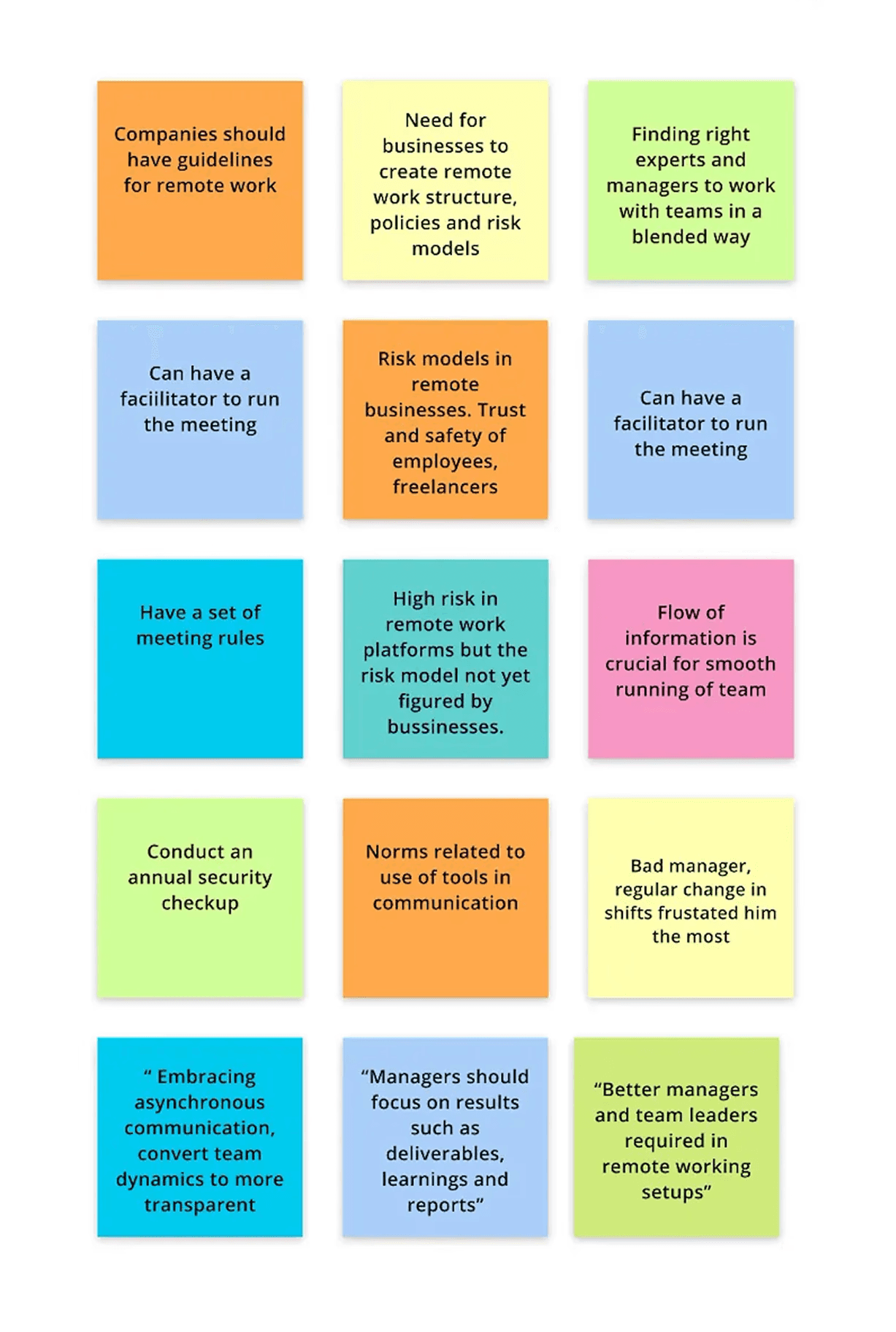
We divided these findings into different categories

We divided these findings into different categories

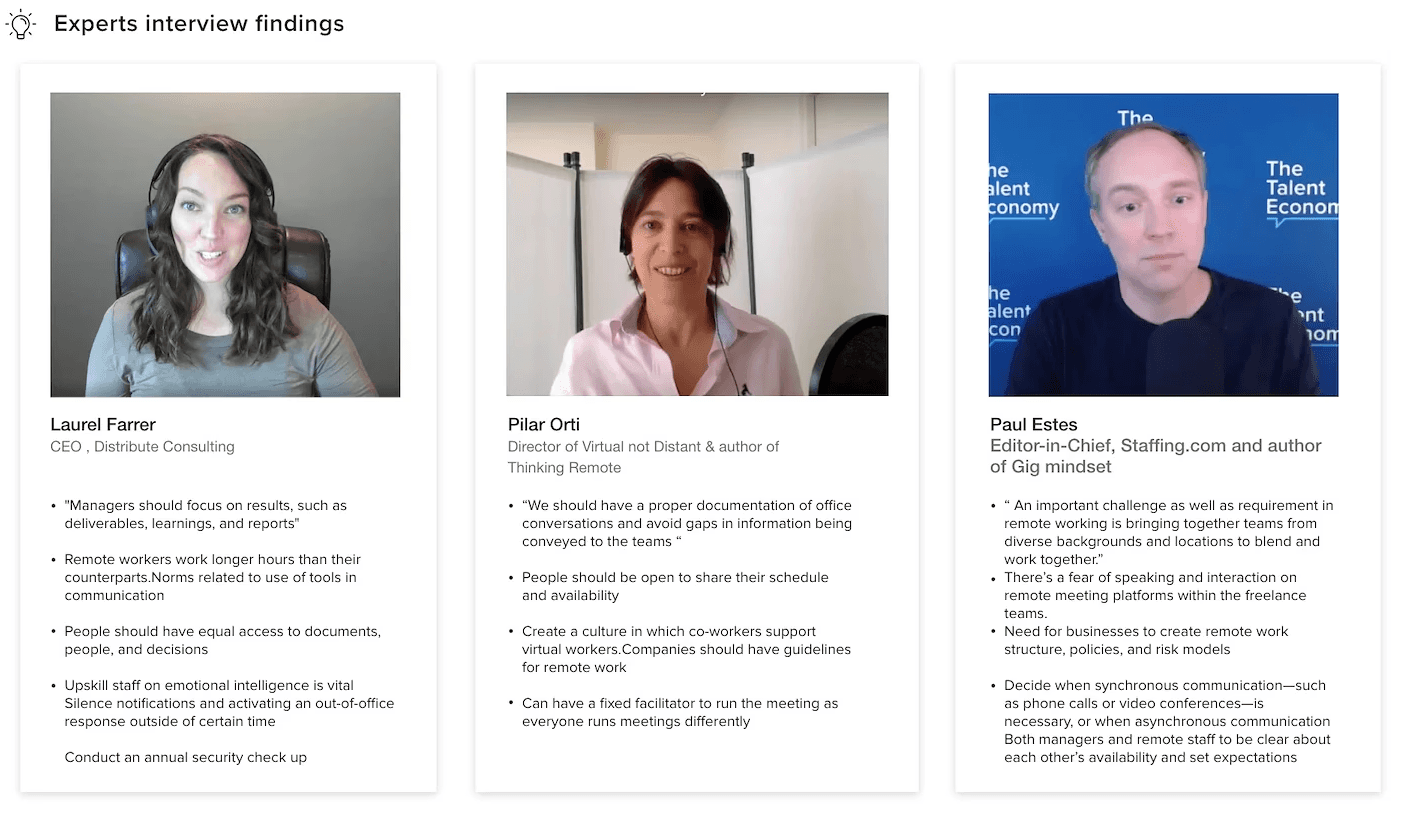
Learning from Industry Experts

Learning from

Industry Experts

Beyond understanding individual user pain points, we wanted to validate our findings from an organizational perspective. We reviewed insights from leading remote work practitioners and consultants to understand how successful distributed teams operate at scale and identify best practices that individual users may not recognize.
In-Context Immersion

Observe how collaboration happens in real remote environments instead of relying solely on interviews.

We observed remote interactions across different settings, including online classrooms, international sprint reviews, and large-scale company presentations. These observations helped us understand collaboration behaviors, communication patterns, and environmental challenges in real-world scenarios.

🎓

Virtual Classroom Observation

Immersion in an online classroom conducted on Zoom
  • Student engagement was significantly lower than in physical classrooms.
  • Teachers found it difficult to monitor participation and learning progress in large classes.
  • Connectivity issues and session limits frequently interrupted lessons.
  • Security vulnerabilities disrupted the learning experience.
  • Students' attention spans were noticeably shorter in virtual environments.
💼

Distributed Sprint Review

Product sprint demo with the Barcelona team in Spain
  • Language barriers affected collaboration.
  • Screen-sharing lag disrupted collaboration.
  • Technical jargon confused non-technical stakeholders
  • The meeting interface competed with shared content for attention.
🎤

Company-wide Town Hall

Observed a CEO presentation attended by 1,000+ employees using Webex
  • Polls increased participation.
  • Large meetings benefited from dedicated facilitators.
  • Ground rules improved meeting communication.
  • Analytics helped measure attendance and engagement.
  • Quiet participants were often overlooked.

Affinity Mapping

We synthesized interview notes, contextual observations, and expert insights using affinity mapping in Miro. Related observations were clustered into meaningful themes that represented recurring patterns across participants.

THEME : TRAINING

THEME : TRAINING

1. There is unfamiliarity with online teaching tools and communication softwares due to lack of adequate and relevant training.

2. People are unaware about existing remote work tools. Ex - One of teachers said she wishes for an offline platform to help her create courses. While in reality, there are such tools which exist.

3. There is a need for training on emotional and mental health for employees who have shifted from office to remote workspaces.

Remote Working Framework

DOCUMENTATION

Socialization

Remote Working Framework

1. Available meeting tools are not fully aligned with the best-practice frameworks and processes required for a 100% remote work environment.

2. Clear guidelines, structured meeting rules, and trained facilitators are critical success factors for effective remote collaboration.

3. Traditional management practices—such as micromanagement, constant employee monitoring, and limited flexibility—are not well suited to a remote working model.

DOCUMENTATION

1. Office conversations should be documented and summarized.

2. Summaries and transcripts of discussions would improve documentation and help teams track key decisions and action items.

3. People want the ability to collaborate on documents while simultaneously participating in video calls.

Socialization

1. People miss the social interactions that come with working alongside colleagues, which affects their enthusiasm and overall work experience.

2. There is a need for greater employee engagement and better visibility into colleagues' activities to foster stronger team connections.

3. A dedicated space for creativity and informal interaction would help people break away from the monotony of remote work.

Exploring Solution Concepts

We translated research insights into a broad set of solution concepts and evaluated them based on user value, feasibility, and business impact. The most promising ideas were shortlisted for prototyping.

concept

Virtual Workspace

Our research revealed that remote employees were forced to switch between multiple communication, collaboration, documentation, and project management tools. This fragmented experience reduced productivity, limited spontaneous collaboration, and weakened the sense of belonging within distributed teams.

We envisioned Virtual Workspace—an AI-powered digital office that recreates the collaborative experience of a physical workplace while bringing essential work tools into a single, connected ecosystem.

What is Virtual Workspace?

Virtual Workspace is an all-in-one collaboration platform that combines communication, documentation, project management, and social interaction into a unified digital workspace.

Inspired by the dynamics of a physical office, it enables distributed teams to collaborate naturally while leveraging AI to improve productivity, reduce burnout, and promote employee well-being.

🎓

Virtual Classroom Observation

Immersion in an online classroom conducted on Zoom
  • Student engagement was significantly lower than in physical classrooms.
  • Teachers found it difficult to monitor participation and learning progress in large classes.
  • Connectivity issues and session limits frequently interrupted lessons.
  • Security vulnerabilities disrupted the learning experience.
  • Students' attention spans were noticeably shorter in virtual environments.
💼

Distributed Sprint Review

Product sprint demo with the Barcelona team in Spain
  • Language barriers affected collaboration.
  • Screen-sharing lag disrupted collaboration.
  • Technical jargon confused non-technical stakeholders
  • The meeting interface competed with shared content for attention.
🎤

Company-wide Town Hall

Observed a CEO presentation attended by 1,000+ employees using Webex
  • Polls increased participation.
  • Large meetings benefited from dedicated facilitators.
  • Ground rules improved meeting communication.
  • Analytics helped measure attendance and engagement.
  • Quiet participants were often overlooked.

Research

Understanding the Remote Work Experience

We adopted a Human-Centered Design (HCD) approach to understand the experiences of employees, managers, and remote work experts. We combined qualitative research with contextual observation to uncover both individual pain points and broader organizational challenges.

Our research focused on answering three key questions:

  • What challenges do employees face while working remotely?

  • How has remote work changed collaboration, communication, and productivity?

• What opportunities exist to create a more connected and engaging digital workplace?