Ecommerce , B2C
Behavioral UX for Ecommerce
Leveraging customer psychology, experimentation, and data-driven design to improve conversion and purchasing behavior across multiple ecommerce brands.
Role
Senior UX Designer
Team
Product owners,
Team Lead, Devlopers
Timeline
-
Tools
Figma, Jira
Domain
Ecommerce
Platform
Desktop, Mobile
THE OPPORTUNITY
During my time at Endless Gain, I partnered with ecommerce brands across retail, pet care, beauty, and consumer products to identify friction in the purchase journey and uncover opportunities for growth. By combining behavioral psychology, user research, analytics, and A/B testing, I designed and validated experiences that helped customers make confident purchasing decisions.
• Conducted UX audits and analyzed customer behavior using analytics, heatmaps, and session recordings.
• Collaborated with CRO strategists, analysts, and developers to define experimentation roadmaps.
• Created hypotheses and designed A/B test variations grounded in behavioral science principles.
• Evaluated experiment outcomes and translated findings into scalable design recommendations.
Approach
Every optimization initiative followed a structured framework:
Research → Insight → Hypothesis → Experiment → Measure → Iterate
By leveraging principles such as Loss Aversion, Social Proof, Choice Architecture, Cognitive Load Reduction, and the Fogg Behavior Model, I designed solutions that aligned customer needs with business goals.
Selected Optimization Experiments
The following examples highlight how research, behavioral psychology, and experimentation were used to solve specific customer and business challenges across different ecommerce brands.
Experiment 1
Increasing Add-to-Cart Rate Through Better Value Communication
CHALLENGE
Analytics revealed that while users were viewing product pages, a significant number were leaving without adding products to their basket. Heatmap analysis showed that users were spending time reviewing product details but often missed key benefits that could influence purchase decisions.
Users needed reassurance and a clearer understanding of the product's value before committing to a purchase.
Heatmap analysis revealed users were spending time reviewing product information but often missed key benefits that could influence purchasing decisions.
Making key benefits more prominent near the primary CTA would reduce uncertainty and encourage more users to add products to their basket.
Control

Control
Modified

The redesigned PDP outperformed the control and helped users evaluate products more confidently.
Variation Outperformed Control
The experiment demonstrated a strong likelihood of outperforming the original experience.
Improved Product Discovery
Users engaged more with product content when video was surfaced within the image gallery.
Purchase Confidence
Making benefits more visible reduced friction and helped users evaluate products faster.
Fogg Behavior Model
Users are more likely to take action when motivation, ability, and a trigger align.
Experiment 2
Simplifying Price Discovery and Understanding
CHALLENGE
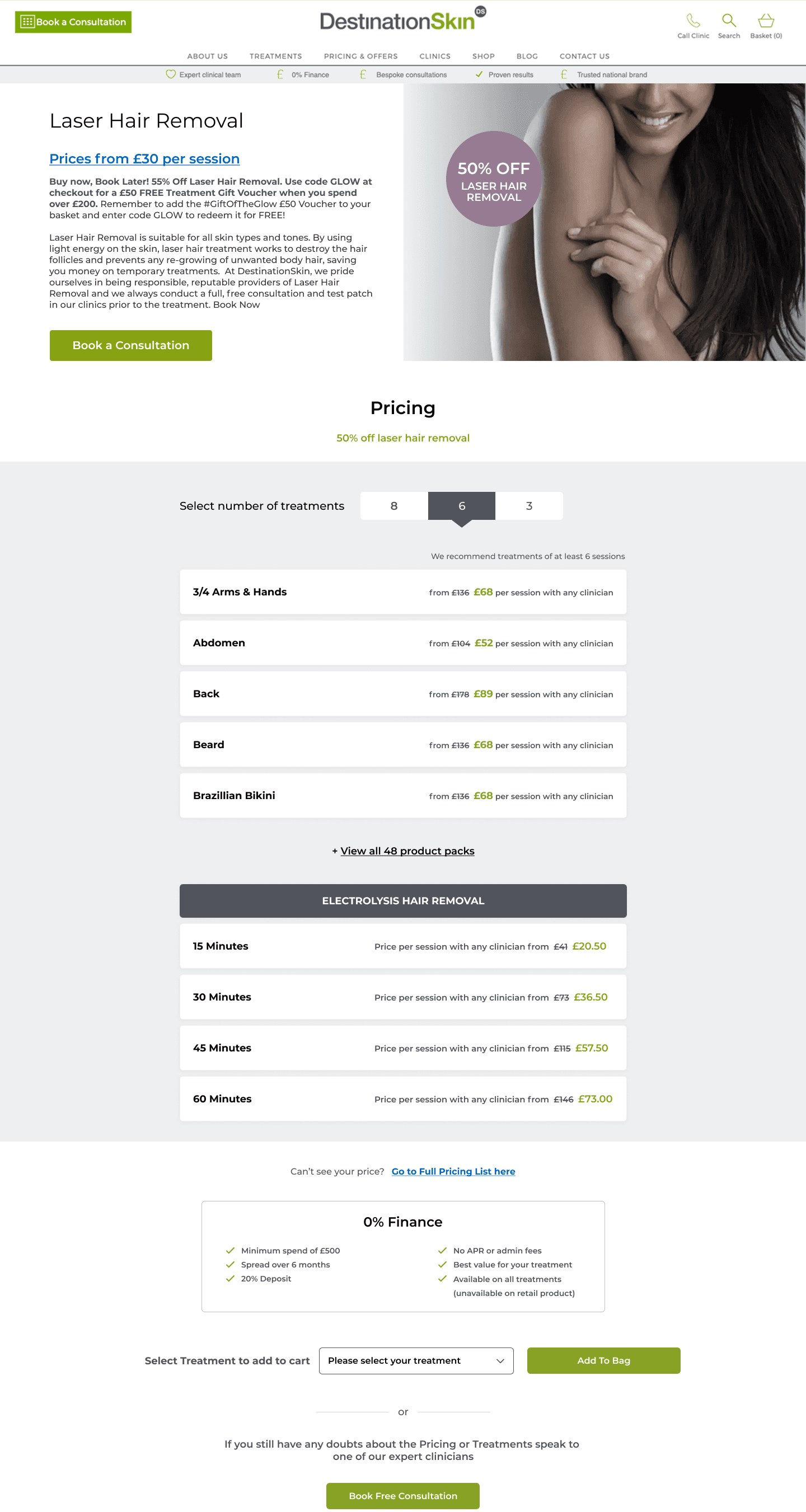
Destination Skin's pricing page contained extensive treatment, pricing, and promotional information. Customers struggled to quickly find relevant treatments, understand pricing structures, and determine available offers.
This created confusion, increased cognitive effort, and made it difficult for users to progress toward booking a consultation.
Price Discovery
78% of mobile users struggled to locate treatment pricing.
Price Clarity
Customers struggled to understand treatment terminology, practitioner differences, and session structures.
Offer Clarity
Users were unclear whether promotional discounts had already been applied and what savings were available.
Customers were looking for a specific treatment rather than browsing the entire price list. Presenting all treatments simultaneously increased cognitive load and made decision-making more difficult.
User interviews revealed that customers felt overwhelmed by the volume of information presented upfront. Many participants struggled to locate specific treatments and compare options efficiently.
Organizing treatments into clear categories and progressively revealing pricing information would help customers find relevant treatments faster and reduce decision fatigue.
Original

Modified

Experiment 3
Increasing Basket Size Through Loss Aversion
CHALLENGE
Analytics revealed that while users were viewing product pages, a significant number were leaving without adding products to their basket. Heatmap analysis showed that users were spending time reviewing product details but often missed key benefits that could influence purchase decisions.
People are generally more motivated to avoid losing a benefit than to gain an equivalent reward.
Biometric research, visitor surveys, and customer interviews revealed that shoppers disliked spending extra money to qualify for free delivery. However, they responded positively when progress toward the reward was made visible and achievable.
Making progress toward free delivery visible would encourage customers to add more items to their basket to unlock the reward.
Solution

Loss Aversion & Goal Gradient Effect
People are generally more motivated to avoid losing a benefit than to gain an equivalent reward.
Experiment 4
Increasing Purchase Confidence Through Social Proof
CHALLENGE
Despite a strong product offering, users lacked sufficient trust signals to confidently make a purchase. Important credibility indicators such as customer ratings, media mentions, and industry recognition were not prominently visible during the decision-making process.
Customers often rely on the experiences and endorsements of others when evaluating unfamiliar brands online.
Industry research consistently shows that reviews, ratings, press coverage, and third-party endorsements help reduce perceived risk and increase trust during purchase decisions.
Making customer ratings, media recognition, and trust signals more prominent would increase confidence in the brand and encourage more users to start their purchase journey.
Solution